From stream pollution to clean discharge
A farm cottage at Owletts Farm, Ashurst Wood, West Sussex
“Before we asked anyone else to look at their system, we put our own right — replacing a setup that discharged to the stream with a plant that treats the waste properly.”
A cottage at Owletts Farm — the farm that hosts the Sort Our Sewage programme — was served by an old septic tank feeding a clinker (filter) bed, which then discharged straight into the stream.
A septic tank only does the first stage of treatment, and while the clinker bed added a secondary stage, the final effluent still went directly to the watercourse. That is exactly the off-mains pattern the programme exists to tackle — and since 1 January 2020 a septic tank discharging to a stream has been against the rules in England.
In short: the host of a clean-rivers programme had a system quietly adding to the very problem it was set up to solve. So it was the obvious place to start.
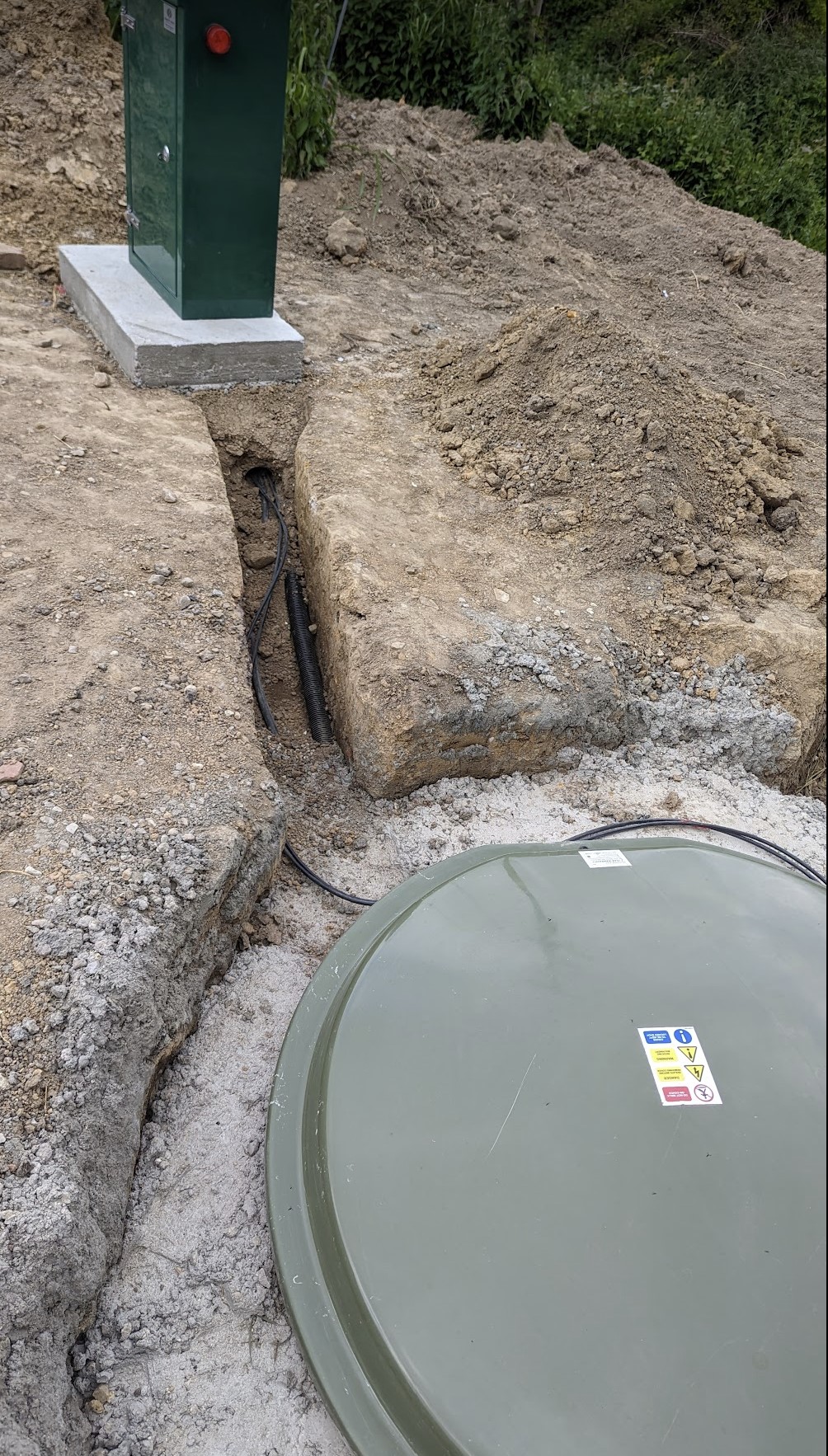
The old setup was replaced with a Kingspan Klargester BioDisc BA-X — a powered package treatment plant rated for nine people (9 PE).
Inside, slowly rotating discs grow a thriving film of bacteria that actively digest the pollution (a rotating biological contactor, or RBC). The result is water clean enough to discharge to the stream within the rules — full secondary treatment rather than the partial job the old system managed.
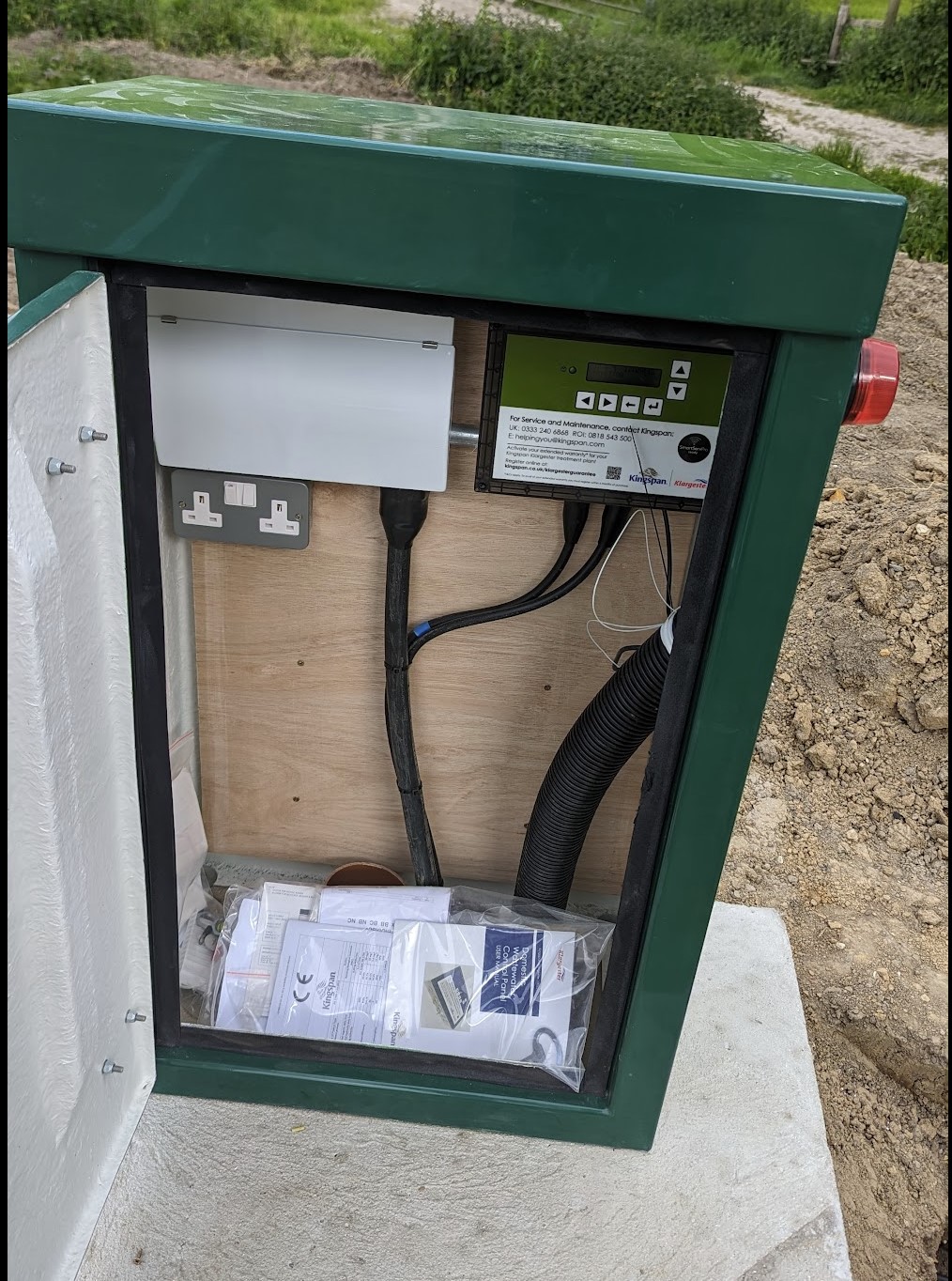
A control cabinet beside the plant runs the unit and raises an alarm if anything goes wrong. The honest trade-off, as with any treatment plant: it needs an electricity supply and an annual service, and the living bacteria must be kept healthy — so no slugs of bleach, and no wipes or fats down the drains.
On site
 Tap to enlarge
 Tap to enlarge
The rundown
At a glance
- The system
- Kingspan Klargester BioDisc BA-X — a rotating-disc (RBC) package treatment plant.
- Capacity
- Nine people (9 PE) — a generously-sized domestic plant.
- How it feeds
- Gravity-fed, 450 mm inlet invert — no pumping station needed for the incoming flow.
- Power & alarm
- Mains-powered, with a control cabinet and a high-level alarm if anything goes wrong.
- What it replaced
- A septic tank → clinker (filter) bed that discharged straight into the stream.
- Where the water goes
- Full secondary treatment — clean enough to discharge to the watercourse within the rules.
- Care & servicing
- Annual service by a competent engineer plus regular de-sludging; keep bleach, wipes and fats out, and keep the power on.
- Installed
- 2023, as part of a whole-farm water, electrical and sewage overhaul — set into the old clinker bed’s excavation.
Want the detail on this kind of system? SeePackage treatment plant.
Why this system
Design considerations
The plant was one piece of a bigger decision. We were re-laying the whole farm’s sewer network at the same time, and we wanted it arranged so a toilet could be added in almost any of the farm buildings later on — so the network, and the plant feeding it, had to be planned around that flexibility rather than a single fixed layout.
We also had nowhere convenient below the buildings for a soakaway or drainage field. That pushed us towards a system that could discharge directly to the stream — which in turn meant we needed the cleanest outflow we could get.
Choosing between systems was harder than it sounds. We spent a good while looking, and the honest truth is that meaningful comparative data is very hard to come by: how clean the outflow is depends enormously on how a system is used, what goes into it, and how it’s looked after. After a lot of digging I was persuaded the Klargester was the best option for us.
Sizing mattered most of all. It had to be big enough to cope with the occasional party, yet small enough to keep a healthy bacterial colony ticking over when it’s just the six of us here day to day — an oversized plant effectively starves its own bacteria. (That balancing act is covered under package treatment plant.)
Our ground is clay and siltstone, and the general view is that soakaways don’t perform well here — water simply doesn’t filter through it fast enough. One honest footnote, though: the standard drainage-field guidelines can be over-conservative, and they bite hardest when you’ve only a small garden to work with. On a farm you often have far more land available, so in practice you can sometimes push further into a soakaway-based approach than the conventional wisdom allows. For us, here, direct-to-stream was still the right call.
So our conclusion was a pragmatic one: choose the system that does the most cleanup it can, accept honestly that we’re still discharging water that isn’t as clean as I’d like, and then build a reed bed just downstream of the discharge point to polish it further. There’s a neighbourly dimension too — a neighbour upstream already runs a Klargester discharging into the same watercourse, so the reed bed we’re putting in will clean up both our outflows, not only ours.
Looking after it
Taking care of our system
A treatment plant runs on a living colony of bacteria, so it pays to be a little kinder to it than you would be to a mains sewer that just whisks everything away. For us that has not meant living like hair-shirted eco-warriors — we still use ordinary washing powder, and we are not anti-bleach. It is a handful of small, genuinely manageable swaps that we reckon keep our Klargester healthy.
- In the dishwasher
- We use Ecover tablets.
- In the wash
- We steer clear of biological washing powder — the enzymes are hard on the bacteria — but otherwise use a perfectly ordinary, non-“eco” powder. No real sacrifice there.
- Cleaning the loos
- Mostly Ecover toilet products and a little more brushing, rather than reaching for the bleach. It honestly takes seconds more. We are not purists, though: if a loo gets properly stinky, a splash of bleach is fine — we just keep it to a minimum rather than pouring it down every day.
- Camper van & tent toilets
- Anything we tip into the system gets septic-tank-safe chemical-toilet fluid — the “green” kind, not the blue formaldehyde type that kills the very bacteria the plant relies on.
None of it is hard, and none of it is about being precious. It just means the plant gets on with its job and the water leaving it stays clean.
Putting it in
Installation
The plant went in as part of a major overhaul of the whole farm’s water, electrical and sewage infrastructure — re-running the sewage pipework, bringing in the electrical supply the plant needs, and laying a water spine that happens to run conveniently alongside it.
Because the groundworks were done together as one project, there isn’t a clean stand-alone figure for “installation” — the digging, pipe runs and power supply were shared across the wider works. That is worth being honest about: on most real sites, the groundworks and connections are a significant part of the total, and they vary enormously from site to site.
One concrete saving did fall out of the design, though: the new Klargester was set into the same excavation that previously held the clinker bed — reusing the existing hole rather than digging a fresh one.
What it cost
The numbers
£5,926.80 inc VAT
| BioDisc BA-X plant (gravity, 450 mm invert, incl. control panel & alarm) | £4,640.00 |
|---|---|
| Commissioning & first-year service bond | £299.00 |
| VAT @ 20% | £987.80 |
| Total | £5,926.80 |
This is the cost of the plant itself plus commissioning — it does not include installation. The groundworks (pipe runs, electrical supply, setting the tank) were part of a wider whole-farm overhaul and can’t be split out as a separate figure. Expect installation and connection costs on top, and to vary a lot site to site.
More to come
This is the first of many
As the milk round gets going we’ll add more real examples from across the Medway. Fixed a system, or looking after one well? Your story could help a neighbour put theirs right.